Embroidery PDF pattern ‘Ottoman Zodiac Embroidery’
The earliest written sources of astrology in the world are found in Mesopotamia and date back to around the 2nd millennium BCE. Since then, many civilizations have developed distinctive astrological imagery that shaped their worldview. By holding this embroidery circle in your hands, you have a unique opportunity to touch, with both thought and hand, the heritage of our human ancestors—experiencing it, discovering it, and at the same time re-creating it in your own way.
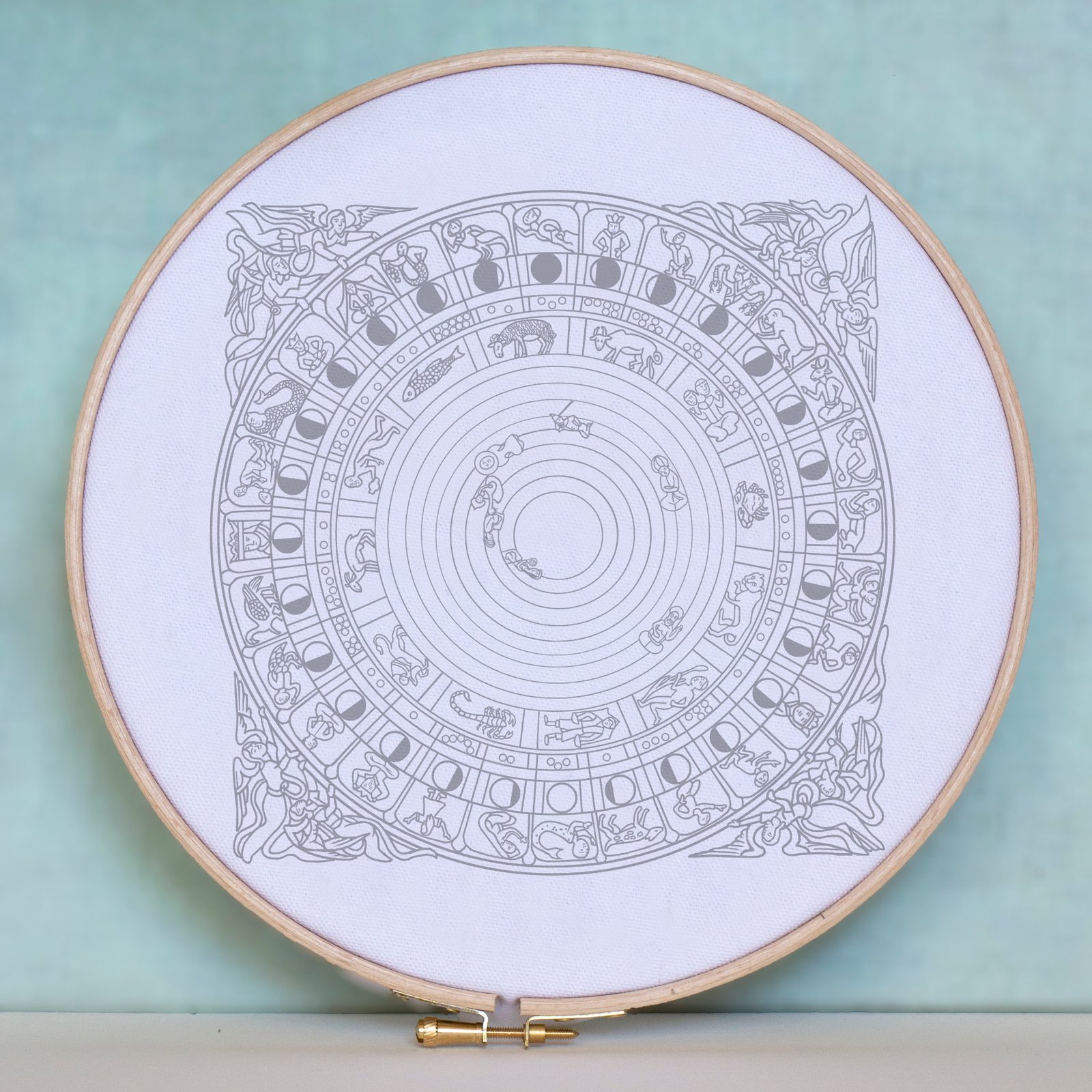
This illustration was created in 1583 in Istanbul, Ottoman Empire, and belongs to the historical manuscript Zubdat al-Tawārīkh (“The Essence of Histories”) by Seyyid Lokman Aşuri, prepared for Sultan Murad III (1546–1595). The miniature reflects the astronomical and astrological traditions developed in the Islamic world, which were strongly influenced by ancient Greek, Persian, and Indian astronomy and astrology. In the medieval Islamic world, astronomy and astrology occupied an important place in scientific, philosophical, and artistic culture, while the movements of celestial bodies were associated with the structure of the cosmos, the measurement of time, and earthly life.
This composition depicts a geocentric model of the universe, with the Earth at its centre, surrounded by seven planetary celestial spheres. These contain personifications of the seven traditional celestial bodies: the Moon holding a mirror, Mercury as a scribe, Venus as a musician, the radiant Sun, Mars as a warrior, Jupiter as a dignified sage, and Saturn as an ascetic. Beyond them, arranged in concentric circles, are the twelve zodiac signs, the phases of the Moon, and the 28 lunar mansions, marking the Moon’s movement against the background of the stars. The human figures, animals, and fantastic creatures depicted in the outer blue ring are symbolic representations of these lunar mansions. In Islamic astronomy and astrology, the lunar mansions were used to determine celestial positions, measure time, and make astrological interpretations.
The four corners of the composition contain four pairs of angels—eight angels in total—whose outstretched wings frame the cosmic circle, which they appear to hold in place. In Islamic cosmological tradition, angels are associated with the celestial realms and divine reality. Here, they surround the entire cosmic structure, symbolically marking the passage into the Divine Presence. The composition as a whole represents the structure of the macrocosm and appears at the beginning of a historical narrative that proceeds from the creation of the world through the stories of the prophets to the history of the Ottoman dynasty.
9,99 €