
Embroidery PDF pattern ‘Persian Zodiac Embroidery’
The earliest written sources of astrology in the world are found in Mesopotamia and date back to around the 2nd millennium BCE. Since then, many civilizations have developed distinctive astrological imagery that shaped their worldview. By holding this embroidery pattern in your hands, you have a unique opportunity to touch, with both thought and hand, the heritage of our human ancestors—experiencing it, discovering it, and at the same time re-creating it in your own way.
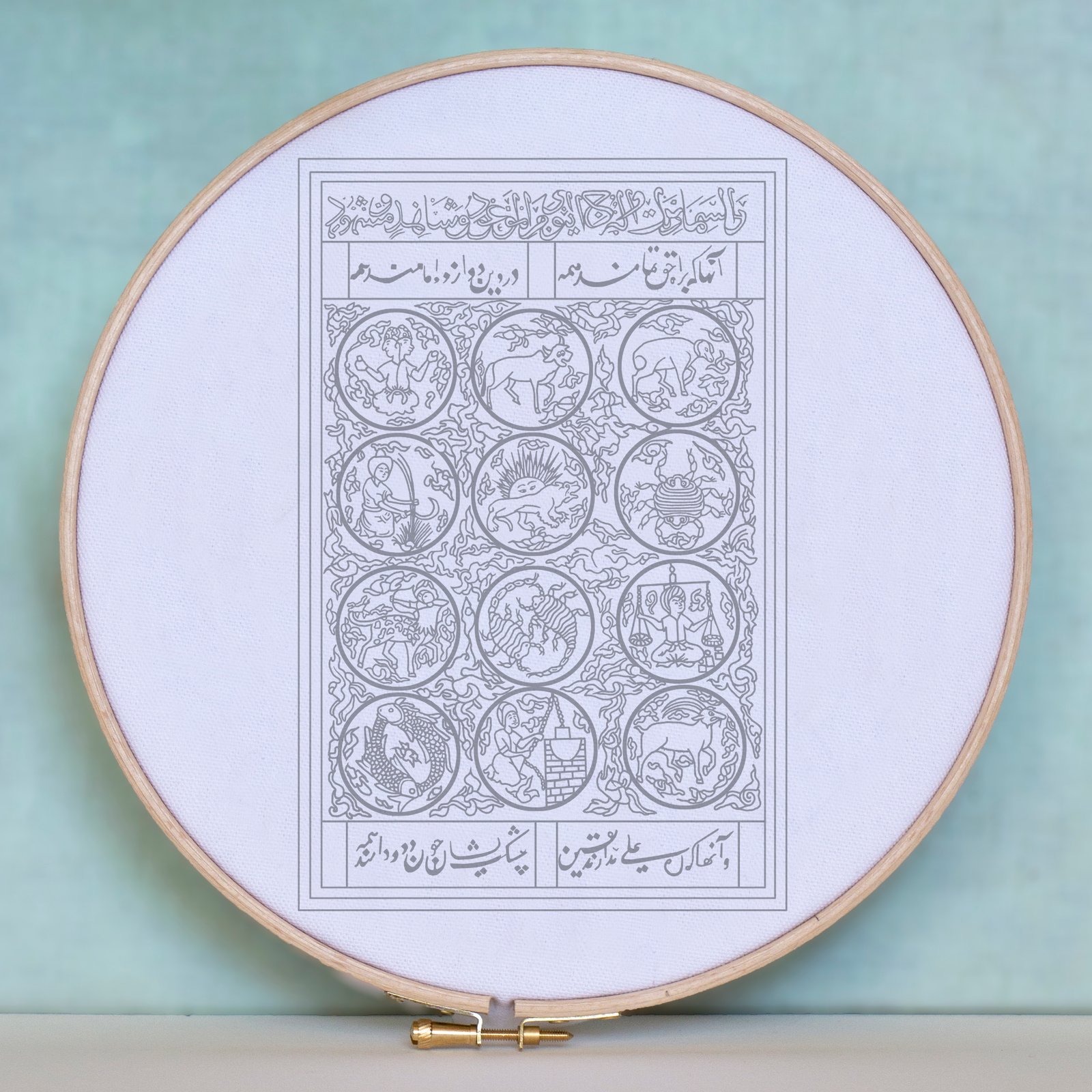
This miniature by an unknown artist, depicting the twelve zodiac signs, was created around the 1570s, probably in Safavid Iran. It belongs to a Persian manuscript known as the Fālnāma (“Book of Omens”), whose illustrations were used for divination and guidance on important matters of life. During the 16th and 17th centuries, such books circulated in Safavid Iran and the Ottoman Empire, where astrology and various forms of divination occupied an important place in religious, intellectual, and cultural life.
The composition depicts the twelve zodiac signs (Arabic: burūj), arranged in four rows of three, each enclosed within a separate golden medallion.
Of particular interest is the religious symbolism of this illustration. The upper part contains the opening verses of the Qur’an’s 85th surah (al-Burūj), which refer to the heavens adorned with constellations. The accompanying Persian couplets associate the twelve zodiac signs with the Twelve Imams, who occupy a central position in the tradition of Shi’a Islam. Thus, astrological imagery acquires an additional religious significance. The divinatory text accompanying the illustration offers a favourable omen, promising success, happiness, and the end of difficulties, while also encouraging caution and religious devotion.
This miniature is a remarkable example of Persian astrological visual culture, bringing together celestial symbolism, religious ideas, and traditions of divination.
9,99 €