
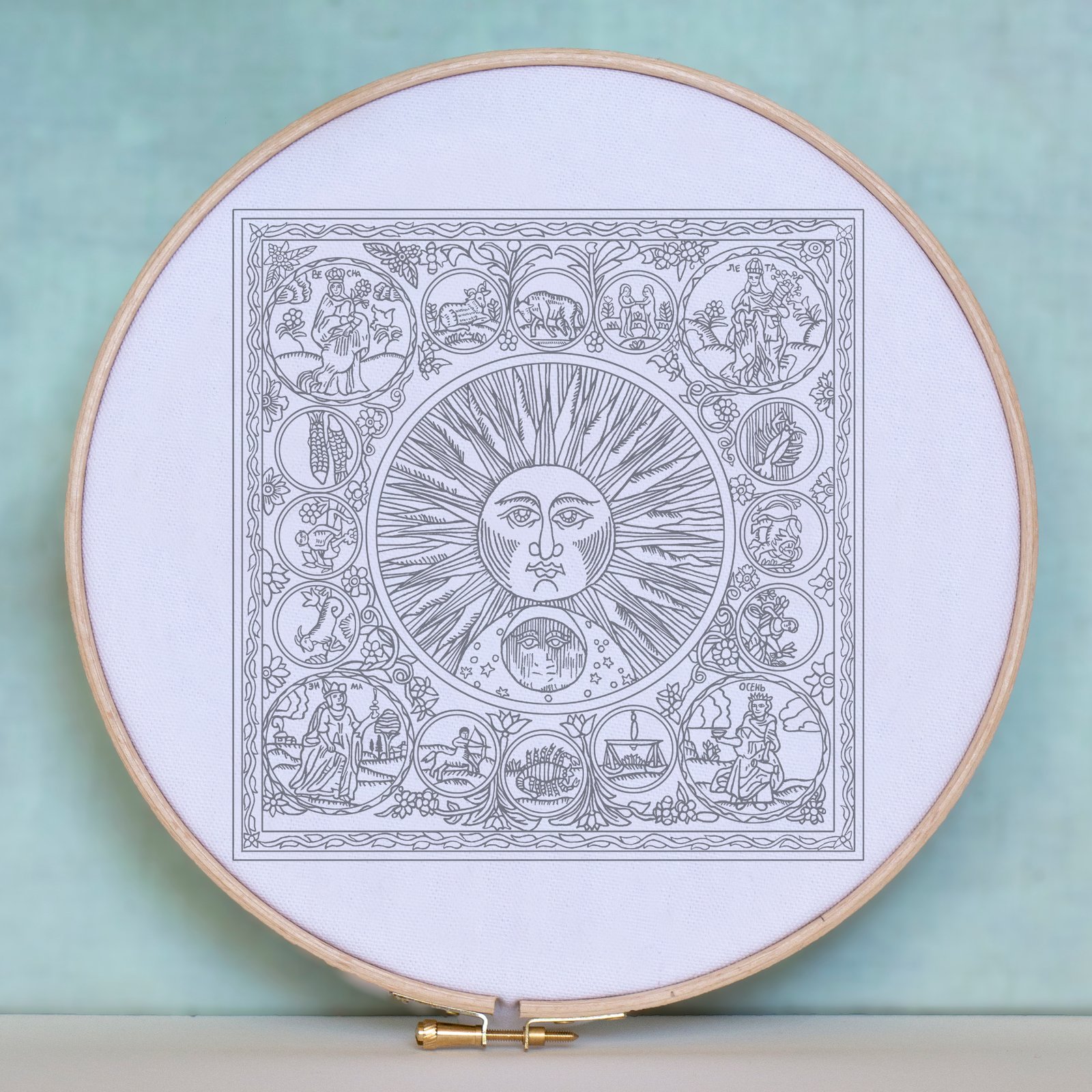
Embroidery PDF pattern ‘East Slavic Zodiac Embroidery’
The earliest written sources of astrology in the world are found in Mesopotamia and date back to around the 2nd millennium BCE. Since then, many civilizations have developed distinctive astrological imagery that shaped their worldview. By holding this embroidery pattern in your hands, you have a unique opportunity to touch, with both thought and hand, the heritage of our human ancestors—experiencing it, discovering it, and at the same time re-creating it in your own way.
This woodcut by an unknown artist, depicting the Sun, the Moon, the four seasons, and the twelve zodiac signs, dates to the late 17th or early 18th century. It belongs to a tradition of popular prints known as lubok, associated with the cultural heritage of the East Slavs. Such prints were used to decorate homes, illustrate religious, historical, and everyday subjects, and convey astronomical and astrological knowledge. The imagery of this work combines ancient Greek and Roman astrological traditions, European allegorical representations of the seasons, and distinctive elements of East Slavic folk art. By the late 17th century, similar large-format calendars depicting the Sun, the zodiac signs, and the seasons were already being printed.
At the centre of the composition is a Sun with a human face, surrounded by rays. Beneath it appears the Moon, likewise depicted with human facial features against a starry sky. Both celestial bodies symbolise the passage of time and the cyclical rhythms of nature. Surrounding them are the twelve zodiac signs, associated with the twelve months of the year. Four larger circular scenes contain personifications of the seasons: Spring accompanied by flowers, Summer with vegetation, Autumn with attributes of harvest and feasting, and Winter represented by a crowned figure. These allegories express the changing seasons, the renewal of nature, and its recurring cycles. The composition is further enriched by floral ornaments and inscriptions in Cyrillic script relating to the zodiac signs and the months of the year.
The composition as a whole forms a kind of cosmic calendar, bringing together the cycles of the Sun and Moon, the zodiac signs, and the seasons into a unified representation of time and the natural order. This work illustrates how astrological symbolism inherited from the ancient world was adopted and reinterpreted in East Slavic artistic culture, becoming part of everyday visual culture.
9,99 €