Embroidery PDF pattern ‘Medieval Zodiac Embroidery’
The earliest written sources of astrology in the world are found in Mesopotamia and date back to around the 2nd millennium BCE. Since then, many civilizations have developed distinctive astrological imagery that shaped their worldview. By holding this embroidery pattern in your hands, you have a unique opportunity to touch, with both thought and hand, the heritage of our human ancestors—experiencing it, discovering it, and at the same time re-creating it in your own way.
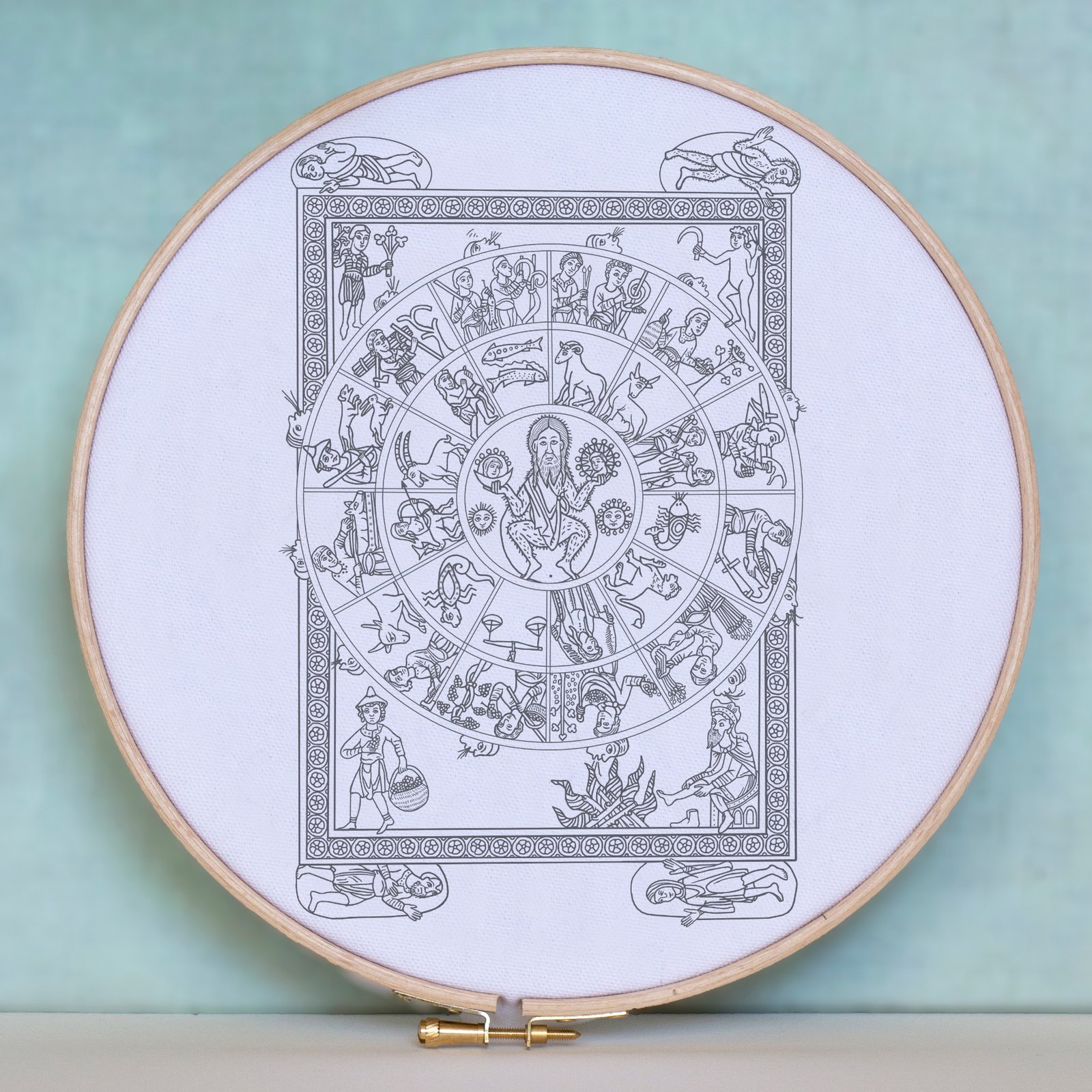
This illustration by an unknown artist was created in the mid-12th century, around 1162, at the Benedictine monastery of Zwiefalten, in present-day Germany. It belongs to an illuminated manuscript containing historical, astronomical, calendrical, and religious texts. The miniature reflects medieval Christian cosmology, in which knowledge inherited from ancient astronomy and astrology was integrated into Christian understandings of the world and time. Such circular diagrams, known in Latin as rotae, were used to explain natural cycles, the movements of celestial bodies, and the order of the universe. They also played an important role in monastic education, particularly in the calculation of time and the determination of religious feast days.
At the centre of the composition is a bearded male figure personifying the Year (Latin: Annus). He holds the Sun and Moon in his hands, accompanied by personifications of Day (Dies) and Night (Nox). Surrounding the central figure, arranged in concentric circles, are the twelve zodiac signs and the twelve months of the year, represented through characteristic human activities and seasonal occupations. Among these scenes are hunting, agricultural work, and other aspects of everyday life, expressing the relationship between human existence and the changing seasons. The edges of the circular composition also contain personifications of the twelve winds.
The four corners of the composition contain allegorical representations of the seasons: Spring (Ver) holding flowers, Summer (Aestas) carrying a sickle, Autumn (Autumnus) with a basket of grapes, and Winter (Hiems) represented by a man warming himself beside a fire. Beyond the rectangular frame appear four additional personifications associated with the times of day, cardinal directions, and natural phenomena: Dawn (Aurora), Hoarfrost (Pruina), Midday (Meridies), and Evening (Vespera). These figures reflect a medieval understanding of time, natural phenomena, and spatial order as interconnected aspects of the cosmos.
The composition as a whole represents the cyclical passage of time and the cosmic order, bringing together the movements of the Sun and Moon, the zodiac signs, the seasons, and human life into a unified vision of the universe. Within the medieval Christian worldview, this cosmic harmony was understood as an expression of the divine order of creation. The miniature is a remarkable example of 12th-century cosmological visual culture, illustrating how astronomical and astrological traditions inherited from antiquity were adopted and reinterpreted in medieval Europe.
9,99 €