
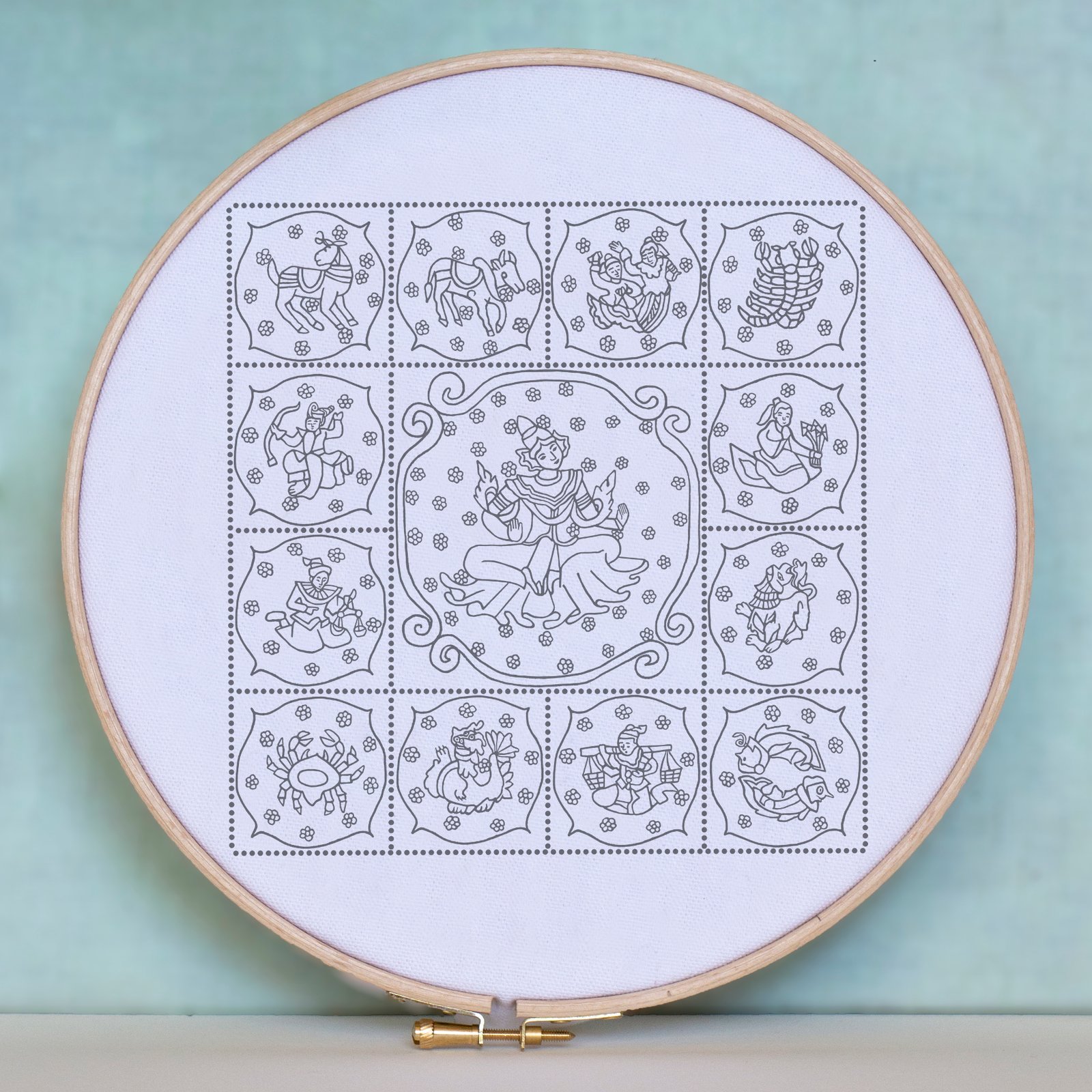
Embroidery PDF pattern ‘Southeast Asian Zodiac Embroidery’
The earliest written sources of astrology in the world are found in Mesopotamia and date back to around the 2nd millennium BCE. Since then, many civilizations have developed distinctive astrological imagery that shaped their worldview. By holding this embroidery pattern in your hands, you have a unique opportunity to touch, with both thought and hand, the heritage of our human ancestors—experiencing it, discovering it, and at the same time re-creating it in your own way.
This textile composition by an unknown artist belongs to the decorative embroidery traditions of Southeast Asia. Its technique resembles kalaga, a form of richly embellished relief embroidery that flourished particularly in 19th-century Myanmar (Burma) during the Konbaung dynasty. Such works were produced using various fabrics, often incorporating silk, velvet, metallic threads, beads, and sequins. They were used to decorate royal interiors and depicted religious, mythological, and astrological subjects. Southeast Asian astrological culture developed through centuries of interaction with Indian astronomical and astrological traditions, which were adopted and reinterpreted throughout the region.
At the centre of the composition is an elaborately dressed four-armed goddess, probably Lakshmi (Sanskrit: Lakṣmī), the Hindu goddess of prosperity, wealth, good fortune, and well-being, and the consort of Vishnu. Her raised hands form symbolic gestures (mudras), while her widely spread skirt resembles the petals of a lotus flower. In Hindu iconography, the lotus symbolises purity, beauty, and spiritual perfection. Surrounding the central figure are the twelve zodiac signs. This twelvefold zodiac system reached Southeast Asia through Indian astrological traditions, whose terminology and imagery were themselves connected to the astronomical and astrological heritage of the ancient Hellenistic world.
9,99 €